What we learn when we bring sound into a place built for noise.
Three years into our facility programs, here's what we've witnessed about resonance, regulation, and what calm actually does to a room.
A correctional facility is not a quiet place. Steel doors slam on a schedule the body learns to anticipate. Intercoms cut through hallways at unpredictable intervals. Fluorescent lights hum at a frequency most people stop noticing — but the nervous system never does. Sound, in these environments, is something that happens to you. It is rarely something offered.
Three years ago, we started bringing singing bowls, tuning forks, and recorded Solfeggio tones into California facilities. We weren't sure what would happen. We are still learning. But what we've witnessed — across hundreds of sessions with residents, officers, and reentry populations — has changed how we think about what calm actually does to a room.
The first ninety seconds
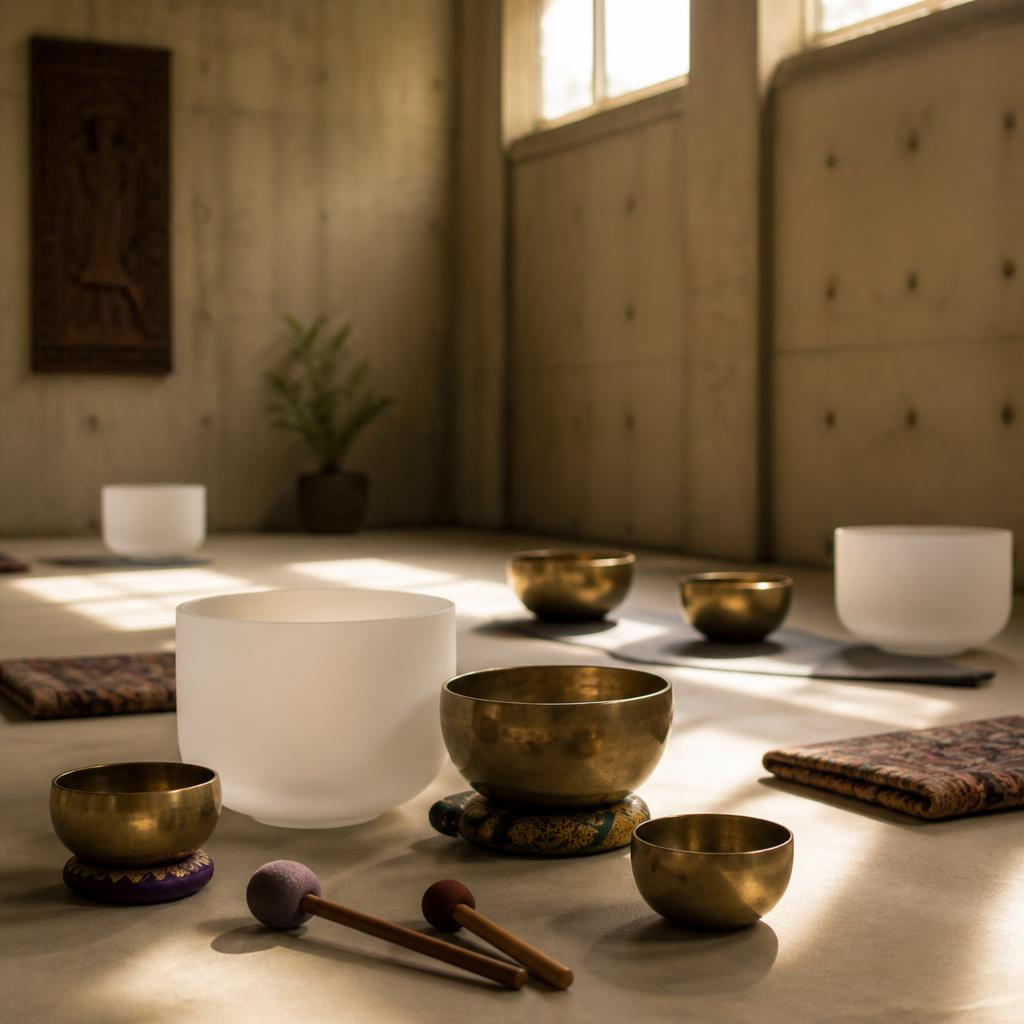
When a brass singing bowl begins to resonate in a room that has never heard one, something measurable happens in the first ninety seconds. Shoulders drop. Conversations end mid-sentence. People who came in skeptical — and many do — uncross their arms without realizing it. We have learned not to talk during those ninety seconds. The sound is the introduction. Words come later.
This is not mystical. It's physiological. Slow, sustained tones in the 110–528 Hz range engage the vagus nerve, the body's primary regulator of the parasympathetic ('rest and digest') response. When the vagus nerve is activated, heart rate slows, blood pressure drops, and the brain shifts out of threat-monitoring. For people who have been living in chronic hypervigilance — which is most people in custody, and a great many who work there — this shift is the first real rest they've had in weeks.
What residents tell us
After every session, we ask one question: what did you notice in your body? We don't ask if they liked it. We don't ask if it 'worked.' We ask what they noticed, because the body is more honest than the mind, and because most of the people we work with have spent years being told what to feel.
"I forgot where I was for a minute. That hasn't happened in eleven years."
— Resident, Central California Women's Facility
We hear variations of this constantly. 'I felt warm.' 'I almost cried and I don't know why.' 'My jaw unclenched.' 'I could hear my own thinking for the first time in a long time.' These are not poetic flourishes. They are nervous-system reports from people whose nervous systems have been on high alert for years, sometimes decades.
What officers tell us
We were invited into staff break rooms before we were invited into housing units. Corrections officers carry one of the highest cortisol loads of any profession in the country. Their divorce rates, suicide rates, and cardiac event rates are all elevated. The job asks them to remain regulated in chronically dysregulated environments — and offers almost no infrastructure for recovery.
A twenty-minute sound session at shift change has, in our experience, more measurable impact on staff wellness than most of the formal wellness programming we've seen offered to corrections personnel. Officers tell us they sleep better the nights they attended. Several have asked for take-home recordings. We make them.
What we've learned about the room itself
Acoustic environments are not neutral. A concrete-and-steel room amplifies harsh frequencies and absorbs warm ones. The bowls have to be tuned for the space. The tones have to be longer than they would be in a yoga studio. The silences between have to be slightly shorter, because in a facility, prolonged silence often reads as threat. We have learned to listen to the room as carefully as we listen to the bowls.
- Slow attack, long sustain — bowls struck softly so the tone builds over four to six seconds.
- Lower fundamentals — frequencies in the 110–256 Hz range feel safer in hard-surface rooms than bright crystal tones.
- Shorter silences — three to five seconds between phrases, not the fifteen to thirty seconds common in studio practice.
- Verbal anchoring — a quiet, predictable voice reminding the room what to expect next.
What we are still learning
We don't claim sound healing cures anything. We don't claim it replaces therapy, medication, or the deeper structural work of decarceration. We claim only what we have witnessed: that a room can change, that a nervous system can soften, and that people who have not been given permission to rest in years will, given a singing bowl and ninety seconds, find their way back to their own breath.
Healing is not something we do for people. It is something we do with them. The bowls are an invitation. What happens after the tone fades is the real work — and it belongs to the person who heard it.
Keep reading
All articles →
528Hz and the body: a layperson's guide
Why this frequency keeps showing up in our work.

The three essential oils we never travel without
Lavender is a start. Here's what comes next.
Breath practices that work inside a cell
Adapted breathwork for tight, loud, fluorescent environments.